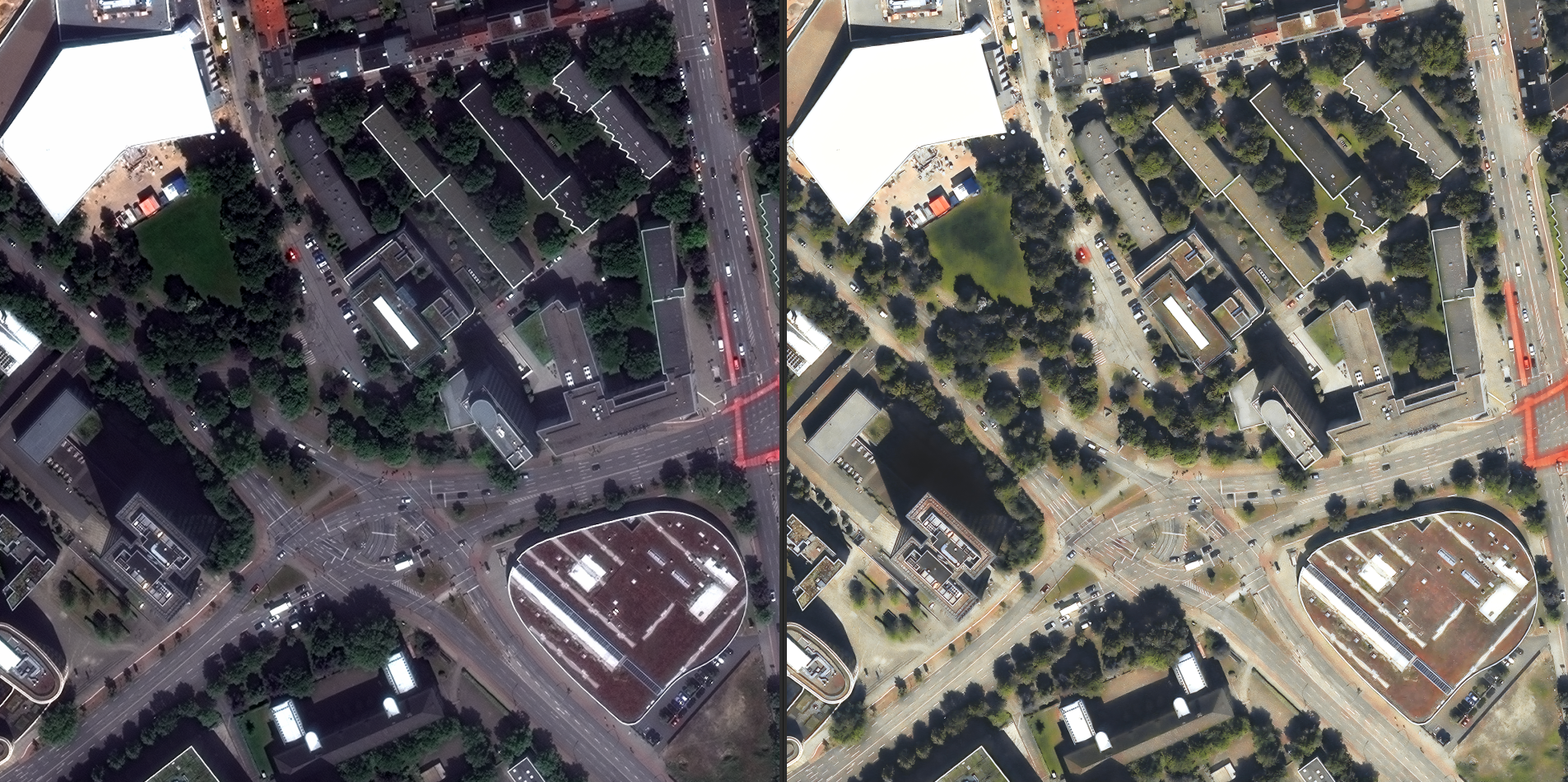
Impervious-surface mapping produces a geospatial picture of the land that water cannot pass through. All land cover divides into two families: pervious surfaces, which let water infiltrate the ground, and impervious ones, which seal it out and force it to run off instead.
What counts as impervious
Impervious surfaces are mostly human-made — roofs, roads, pavements, car parks — though some non-porous rock formations qualify too. Each surface type interacts with rainfall differently, and that interaction can be quantified.
The runoff coefficient
A surface's contribution to runoff is captured by its runoff coefficient — the ratio of runoff volume to the precipitation that fell on it. A dense roof or asphalt lot approaches 1; vegetated ground sits far lower. Multiply accurate, classified impervious area by the right coefficients and you can model how a catchment responds to a storm.
That is why precise, current impervious-surface data — produced by classifying imagery into detailed land-cover types — underpins stormwater planning, flood modelling and fair utility-fee calculation.